Enterprise software teams keep getting asked the same question: which model should we wire into our AI agents? And when budget and response speed matter just as much as capability, how do we choose?
Scores on general leaderboards don’t answer that. Being good at coding or math doesn’t mean a model can create a valid purchase requisition inside a live business system.
That’s why Nocoly & Mingdao AI Tech Group built BenchSaaS, an enterprise application LLM benchmark. It puts models to work on real business data and checks whether the job actually got done. It evaluates the models, not Nocoly’s own workflows. The V1.0 rankings and full 51-page English report are now public—direct download, no sign-up required.
This benchmark is written primarily for two audiences:
Enterprise Software Peers
Partners, customers, and teams building enterprise AI agents. Sooner or later, you have to choose a model for your agents—and you need experimental evidence you can cite.
Foundation Model Labs
Teams that want to see how their models perform in real business operations and which step fails. When a new model releases, bring it here to test.
First, spend two minutes seeing how we ran the evaluation.
BenchSaaS V1.0 Project Overview.
The Rankings Not Revealed in the Video
We tested 10 mainstream models across Low, Mid, and High reasoning tiers—30 configurations in total. Each of the 100 business tasks ran 3 times, yielding 8,850 valid runs and an aggregate solve rate of 90.25%.
#1 overall is Gemini 3.8 Flash (medium) at 97.94%. Its high tier ranks #2 at 97.24%, followed by Kimi K3.1 Pro (max) at 96.99%.
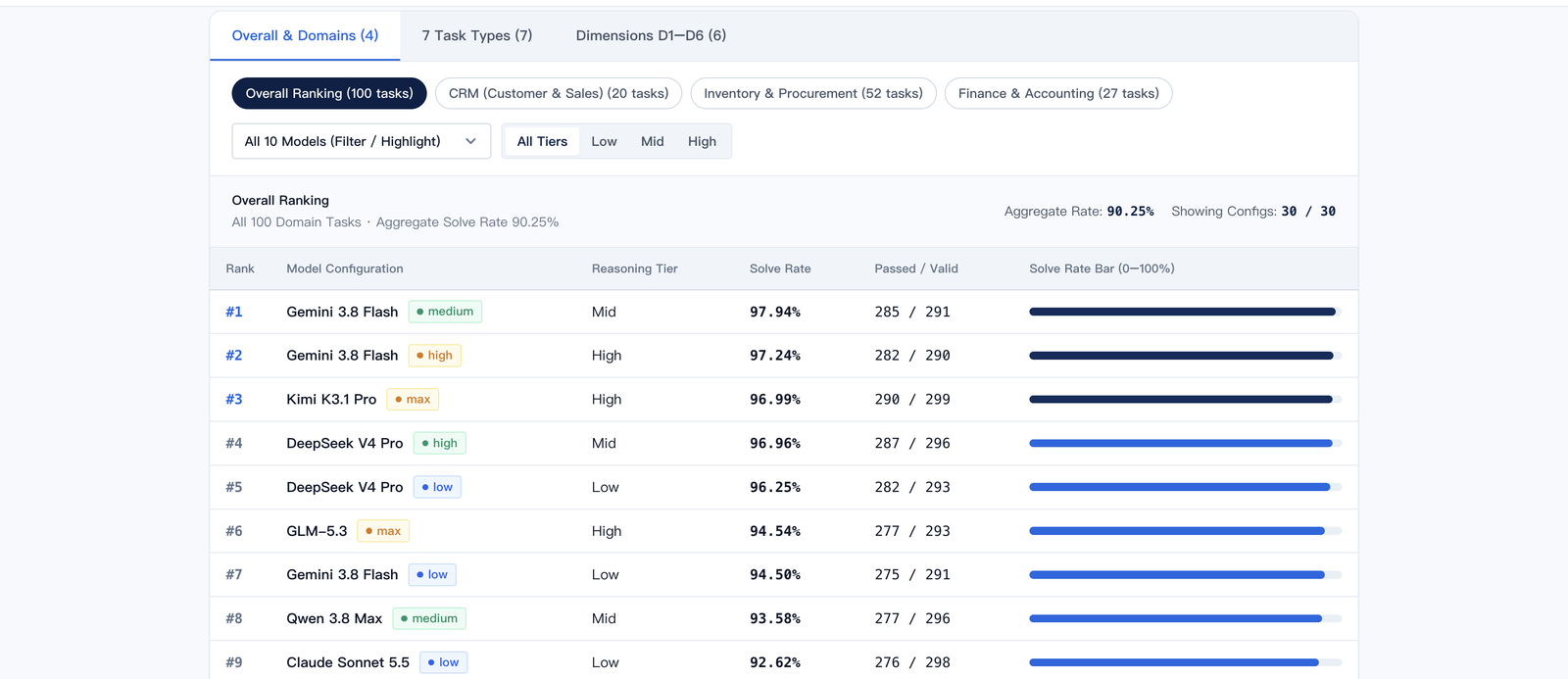
General leaderboard on nocoly.com. Since vendors name reasoning tiers differently, each model is labeled with its native parameter—for example, medium for Gemini’s Mid tier and max for Kimi’s High tier.
Yet there is no single all-around winner. In CRM, 6 configurations tied at 100%. In Inventory, GPT-6.1-Terra (low) led at 98.72%. Finance was the hardest of the three domains at an 86.56% aggregate solve rate, topped by DeepSeek V4 Pro (low) at 100%.
Turning reasoning effort higher doesn’t automatically improve results either. GLM-5.3, Kimi K3.1 Pro, and GPT-6-Luna improved sharply as effort increased; Gemini 3.8 Flash (medium), DeepSeek V4 Pro (high), and Qwen 3.8 Max (medium) all peaked at the Mid tier; while MiniMax M3.1 Flash actually declined at higher settings.
Saying “It’s Done” Isn’t Done
Record querying, process tracing, data maintenance, and auditing/reconciliation all hovered around 95%. What really separated the models was creating business documents, which dropped to 76.99%—roughly 20 percentage points lower.
The reason comes down to how tasks are graded. Query tasks check against reference answers. Write tasks go further: we read back live business records in Nocoly HAP via API to verify whether the document was actually created and every required field was populated. Across 863 failures, 593 missed mandatory assertions—428 response failures and 165 database record mismatches.
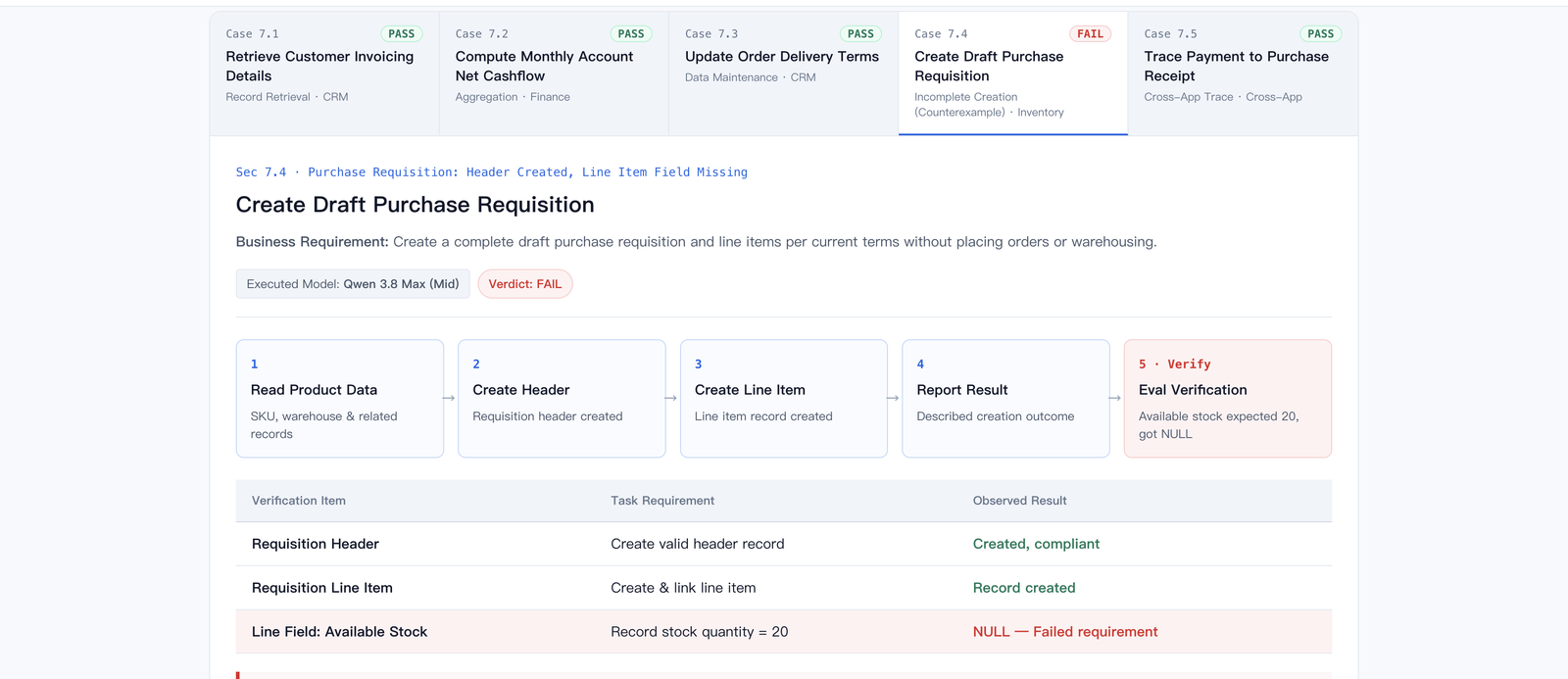
A real failure case on the website: the model created both the purchase requisition header and line item and replied that it succeeded, yet left the required “Available Stock: 20” field null in the line item. Across 30 configurations, pass rate on this task was only 44.32%.
Choosing a Model Also Comes Down to Cost and Time
The #1 configuration isn’t always your best choice. Gemini 3.8 Flash (medium) costs roughly CNY ¥0.55 per run (API usage metered in CNY), not the cheapest. If budget matters more, GPT-6-Luna (medium) runs around CNY ¥0.03 per task at a 90.97% solve rate. If speed matters more, DeepSeek V4.1 Flash (low) has a 49-second median latency, 90.91% solve rate, and costs around CNY ¥0.08 per run.
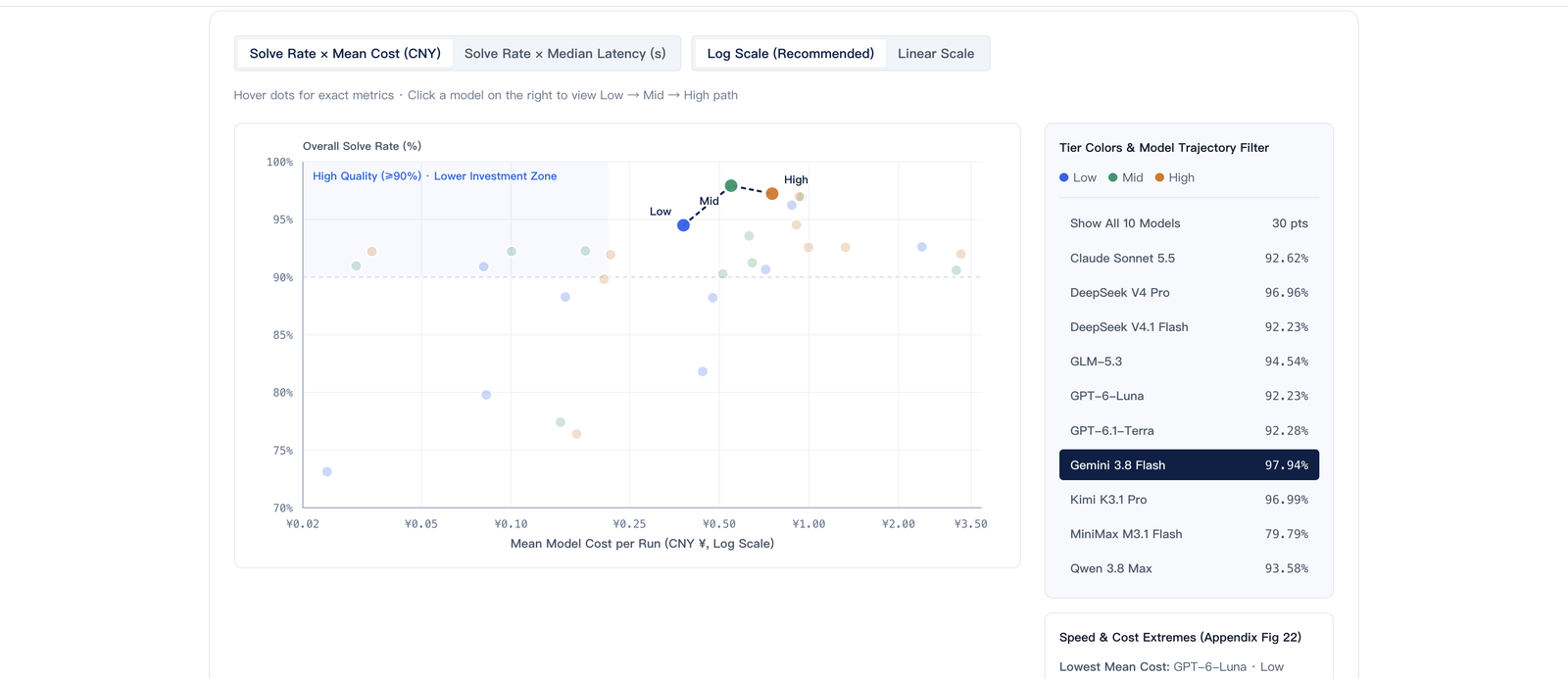
Solve rate vs. mean model cost per run (log scale). Top-left is the high-accuracy, lower-cost zone. The connected path shows Gemini 3.8 Flash across Low, Mid, and High tiers—click any model on the site to inspect its curve.
These are pragmatic alternatives, not second-place winners. Trading between accuracy, latency, and cost for your actual business workflow is far more useful than chasing rank #1 blindly.
Why Use Nocoly HAP as the Testbed
Enterprise applications vary widely, yet what AI agents do inside them looks largely the same: query records, create documents, update fields, reconcile numbers, and trace processes. Nocoly HAP provides two essential qualities.
Universal. CRM, inventory, and finance run on a single platform, representing the most common enterprise workflows. Isomorphic. Different applications share the same underlying table, field, relation, and permission architecture—so when a model switches domains, the rules stay consistent and results stay comparable. Nocoly HAP also logs every API call and read/write operation, which is where all failure attributions on the site come from.
V1.0 uses off-the-shelf marketplace apps—40 tables and 18,014 live business records—rather than toy schemas built just for testing. Tasks are designed around seven enterprise operational types and do not claim to cover every vertical industry.
Explore the Full Results on the Website
On the website, you can filter all 30 configurations by business domain, task type, and reasoning tier, inspect all 863 failure causes, and walk through five representative tasks from data lookup to final verification. The 51-page English report PDF is free for direct download.
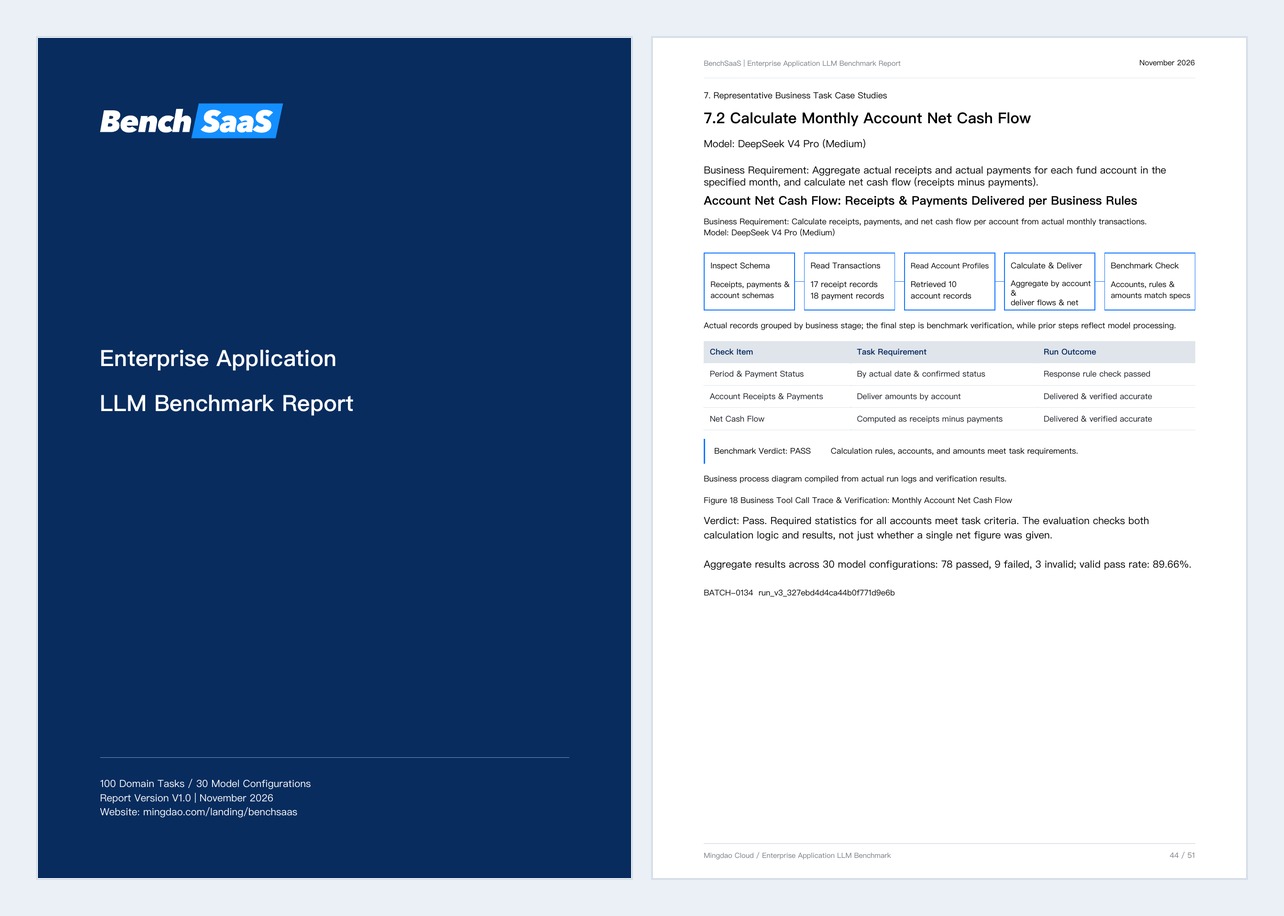
51-page English report cover and sample case study spread.
BenchSaaS releases quarterly. Inference service providers can contribute token resources to support upcoming evaluations; model developers can join the next round and receive our public task subset plus diagnostic reports to see exactly where models fall short. Use the partnership form at the bottom of the page.